

Wear this vintage design on a wide variety of apparel by going right here. Or, check out dozens of other one-of-a-kind, extraordinary designs by going here.
Vintage R rating and the history of MPAA Ratings
Founded in 1922 as the Motion Picture Producers and Distributors of America, the organization that became the Motion Picture Association of America emerged after a wave of Hollywood scandals. Under Will H. Hays, it imposed self-censorship through the Production Code of 1930, enforced strictly from 1934. By the 1960s, however, the code seemed outdated. Changing social norms and films like Who’s Afraid of Virginia Woolf? pushed the industry toward a new approach.
Change in the 60s
Under president Jack Valenti, the MPAA introduced a voluntary ratings system on November 1, 1968. Its original categories were G for general audiences, M for mature audiences, R for restricted, and X for no one under 16 admitted. Almost immediately, “M” caused confusion because it suggested restriction but allowed all ages. In 1970, M was replaced by GP, meaning “General audiences, Parental guidance suggested,” and in 1972 GP became PG. At the same time, the age threshold for R and X was raised from 16 to 17. R meant viewers under 17 required a parent or guardian, while X barred anyone under 17.
The early ratings evolved rapidly. The X rating, never trademarked by the MPAA, was quickly adopted by the adult-film industry, making it stigmatized and commercially damaging for serious films. This tension shaped censorship debates throughout the 1970s. The system was intended to inform parents rather than ban content, but filmmakers often battled the ratings board over what earned an R or X. In 1984, after complaints about intense sequences in Indiana Jones and the Temple of Doom and Gremlins, the MPAA added PG-13, though the basic framework remained rooted in the late-1960s system.
The Vintage R Rating from the 1970s and 1980s
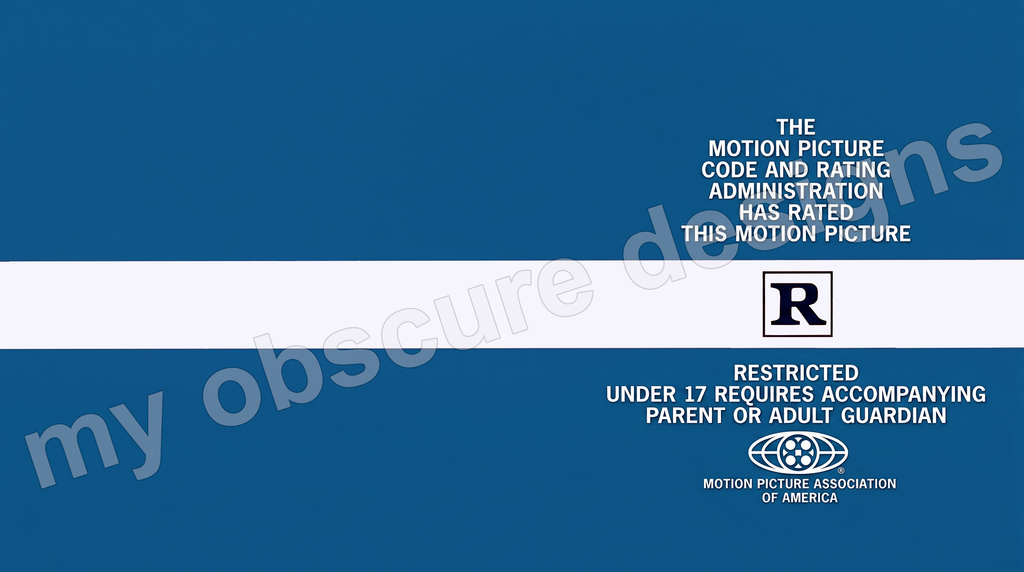
Before features in the 1970s and 1980s, audiences saw the rating as a static card, typically on a dark blue background like the image above. A bold outlined rectangle contained the large rating symbol (G, PG, R, or X) often in simple sans-serif type. Inside or below the box appeared phrases like “Parental Guidance Suggested” or “Under 17 Requires Accompanying Parent or Adult Guardian,” alongside the MPAA name.
The same square symbol appeared on posters, newspaper advertisements, and marquees. Trailers used colored bands: a green band indicated previews approved for all audiences, while a red band signaled restricted previews. These cards became an instantly recognizable ritual before the feature, visually reinforcing the MPAA’s role as gatekeeper of movie content.