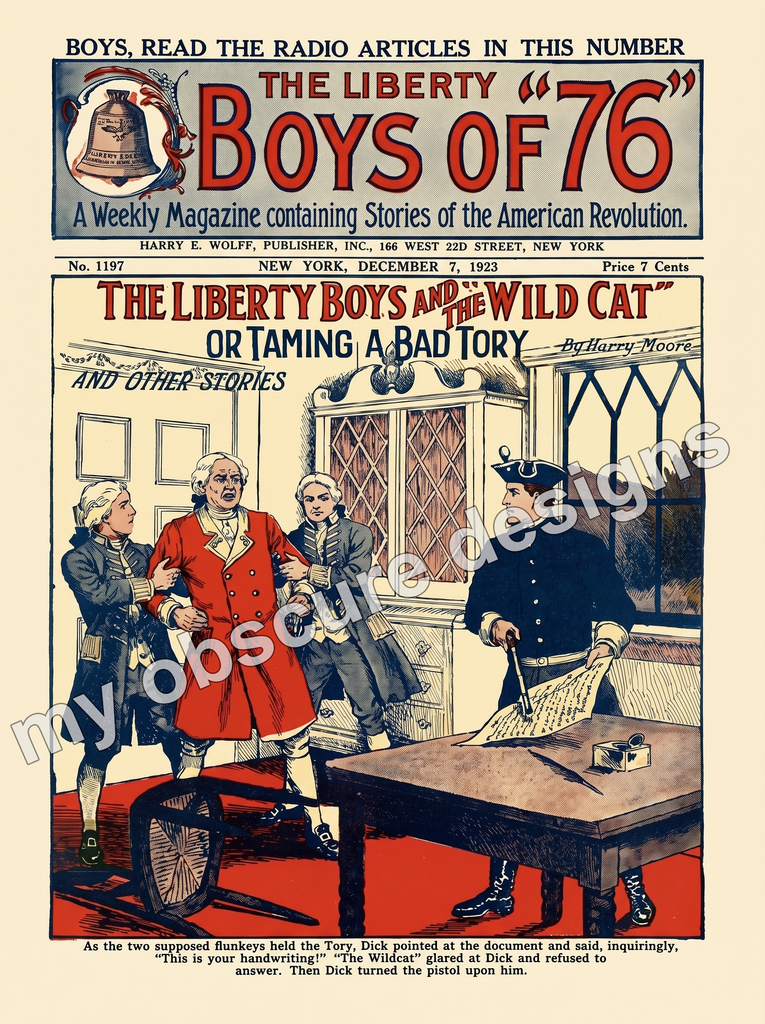
Let’s get old school about entertainment for young people… very, very old school. So old school that we’re talking about dime novels, which would wind up being supplanted by comic books. The Liberty Boys of 76 is a great example of the soon-to-disappear dime novel (which was actually seven cents). Enjoy this dime novel design on products such as this:
You can have this nostalgic design on a wider variety of high-quality merch that can be found right here. Or, peruse dozens of other remarkable designs from My Obscure Designs that can be found right here.
The Liberty Boys: A Forerunner of Early 20th Comic Books
In the early decades of the twentieth century, American children looked to print for excitement. Long before television and just as radio was being introduced into American homes, boys devoured illustrated serials such as The Liberty Boys of 76.
This long-running juvenile weekly followed young Revolutionary War patriots through battles, disguises, and narrow escapes, and it thrived in an era when comic books as we know them had not yet fully emerged. Such story papers and dime novels helped build an audience eager for thrilling, episodic adventure. They also paved the way for the popularity of comic books, which was about to emerge.
Dime Novels Gave Way to Comic Books
The comic book form itself began taking shape in the 1920s and more so in the 1930s. Publishers initially reprinted popular newspaper comic strips in magazine-sized pamphlets. Funnies on Parade and Famous Funnies demonstrated that readers would pay for collected strips.
In 1935, New Fun Comics offered original material rather than recycled newspaper content, proving that comic books could be a creative medium of their own. The format was cheap, portable, and colorful, often selling for ten cents and appealing strongly to children and teens.
The Superhero Era
The genre changed dramatically in 1938 when Action Comics #1 introduced Superman. The superhero boom followed, with Batman debuting in Detective Comics #27 in 1939 and many other caped heroes appearing soon after. Superheroes dominated the late 1930s and 1940s, but early comic books also included detective stories, Westerns, science fiction, funny-animal humor, crime, horror, and romance.
During World War II, patriotic heroes fought Axis spies and saboteurs on cover after cover, making comics a source of wartime entertainment and morale-building. Soldiers as well as children read them, and millions of copies circulated monthly.
A New Mass Medium
By the late 1940s, comic books had become a major mass medium. Their roots, however, lay in a pre-electronic world where print was the primary source of serialized adventure. The popularity of end-stage dime novel titles like The Liberty Boys of 76 revealed that young readers wanted heroic action and cliffhanger endings. Comic books simply gave those desires a visual form. And it’s form that is still with us today.
In a simpler age, dime novels and comic books shaped the imaginations of a generation before radio and television came along and transformed youth entertainment forever.