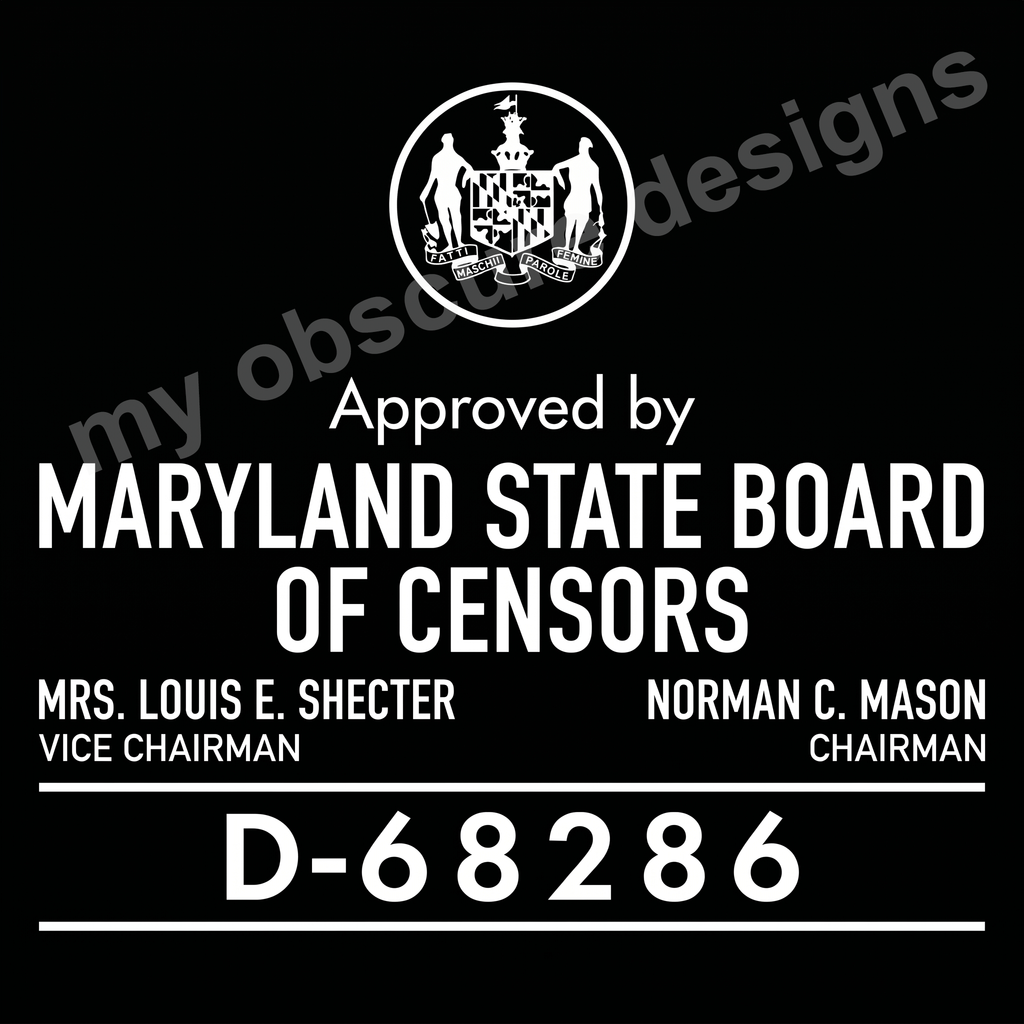
Maryland audiences saw this seal before every movie back in the day. Show off this ridiculous aspect of Maryland’s past. Yes, wearing this ironically is fun!

Get this infamous seal on a variety of quality products right here. Or, have a look at dozens of other unique designs from My Obscure Designs that are available right here.
History of the Maryland State Board of Censors
The Maryland State Board of Censors was established in 1916 as a state agency with authority to review motion pictures before public exhibition. Its three members, appointed by the governor, could approve films, demand cuts, or refuse licenses for material they considered obscene, indecent, sacrilegious, or otherwise harmful. For decades, virtually every commercial film shown in Maryland had to pass the board, making it one of the longest-lasting state censorship bodies in the United States.
By the 1960s the board faced growing legal challenges. In Freedman v. Maryland (1965), the U.S. Supreme Court ruled that Maryland’s censorship procedures violated the First Amendment because they lacked prompt judicial review. The board survived, but its power was weakened and its old-fashioned standards increasingly clashed with rapidly changing cinematic culture.
Filmmaker John Waters and Battles with the Board
Baltimore filmmaker John Waters became the board’s most notorious opponent. His early underground films, including Multiple Maniacs (1970) and especially Pink Flamingos (1972), were deliberately outrageous, mixing sacrilege, sexual transgression, and pure gross-out humor. The Maryland censors objected strongly, demanding extensive cuts. Waters refused and turned each fight into publicity, mocking the board as an emblem of repressive taste.
Pink Flamingos, with its infamous scatological climax and unabashed offensiveness, was denied a commercial license in Maryland, forcing it into midnight screenings and noncommercial venues. Its banned reputation effectively served to help build Waters’ cult following.
Decline and Fall
By the late 1970s, shifting obscenity standards, court rulings, and budget pressure had made the board increasingly irrelevant. It was abolished in 1981, ending Maryland’s experiment with state film censorship. Waters’ battles with the censors remain one of the board’s most colorful final chapters.