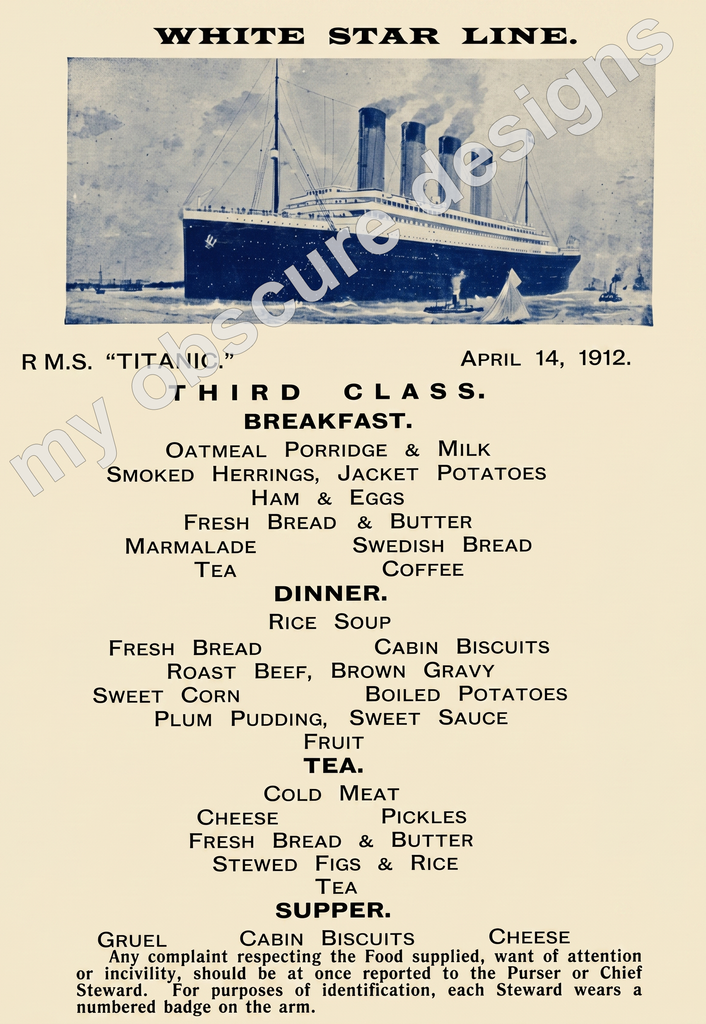
Make a statement with this design. At the same time, be glad you’re seeing this menu now rather than ordering from it during the last day of that ill-fated voyage.
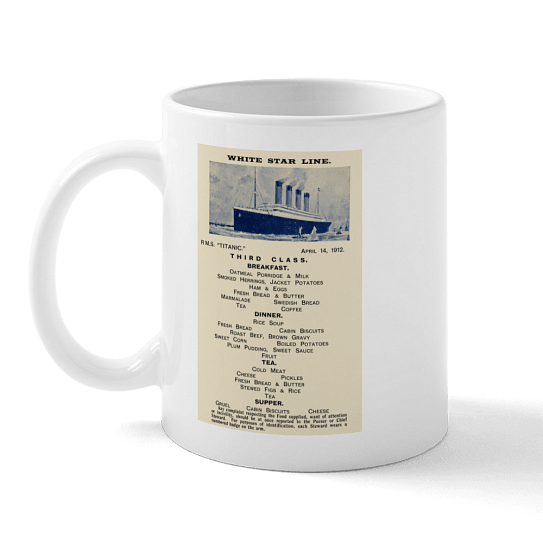
Check out this design on dozens of other items right here. Or check out a wide variety of other designs by visiting here.
A Brief History of the Titanic Sinking
The R.M.S. Titanic sank in the North Atlantic on April 15, 1912, after striking an iceberg during her maiden voyage from Southampton to New York. The ship carried around 2,200 passengers and crew; more than 1,500 died. The disaster did not strike all equally. Class determined comfort, access, and ultimately survival. First-class passengers survived at more than double the rate of third-class passengers.
At 11:40 p.m. on April 14, lookout Frederick Fleet spotted an iceberg dead ahead. The Titanic turned, but the iceberg opened six forward compartments. The ship’s designer, Thomas Andrews, quickly realized the “unsinkable” liner could stay afloat only about two hours. Distress rockets were fired, and lifeboats began loading around 12:25 a.m. By 2:20 a.m., Titanic had sunk. Those left in the freezing water died within minutes.
The survival figures reveal a stark class divide. Of roughly 325 first-class passengers, about 202 survived, a rate of 62%. Of about 285 second-class passengers, 118 survived, or 41%. Among approximately 706 third-class passengers, only about 178 survived, or just 25% of the total.
In raw numbers, around 528 third-class passengers died, more than first- and second-class deaths combined. First-class men survived at a higher rate than third-class children. The rule of “women and children first” was applied unevenly. Nearly all first-class women and children reached the boats, while many third-class families remained trapped below.
Dining on the Titanic
Aboard the Titanic, class shaped every daily ritual, including meals. First-class passengers dined in an opulent saloon on ten-course menus featuring oysters, consommé, poached salmon, filet mignon, lamb with mint sauce, roast duck, pâté de foie gras, and elaborate desserts such as peaches in chartreuse jelly.
Second-class passengers ate simpler but respectable fare: baked haddock, curried chicken and rice, roast turkey with cranberry sauce, and plum pudding.
Like the final Titanic menu shown above, third-class passengers, many of them emigrants, ate plain, filling meals in communal dining rooms, including porridge, stew, boiled potatoes, bread, rice soup, and tea. These separate dining worlds mirrored the ship’s physical layout. The third-class eating area, while plain, would be considered upscale for many of the poorer immigrants aboard.
Third-Class Passengers Never Stood a Chance
Third-class berths were deep in the lower decks, far from the boat deck. The ship’s maze of corridors, locked gates, and barriers (some kept closed to separate steerage passengers from upper decks) slowed escape for unlucky third-class passengers.
Many in 3rd-class spoke little English, received little guidance, and were told to wait. By the time many reached the boat deck, most of the lifeboats were already gone. Sadly, the Titanic carried only enough lifeboats for about half the people aboard, and several were launched partly empty.
The Titanic: A Lesson in Hubris
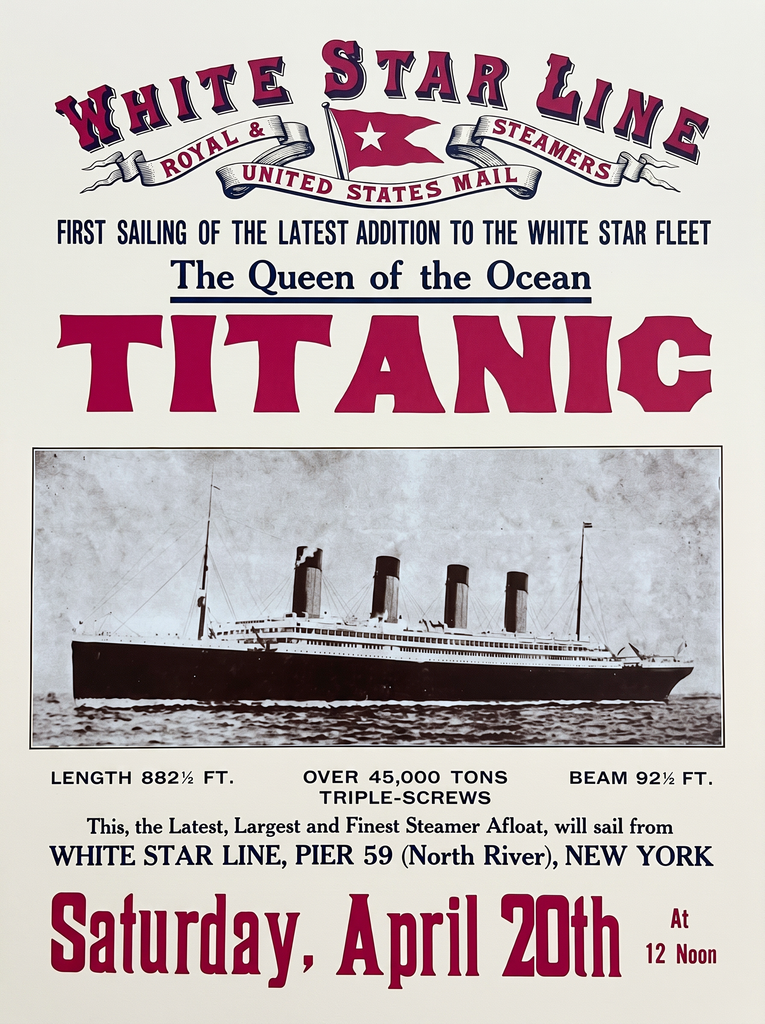
The Titanic disaster was a failure of navigation and engineering. It was also a failure of social justice. The class system that designated different meals and different accommodations aboard the ship became, on that April night, a matter of life and death. How much someone paid for a ticket literally dictated whether or not they would live after the collision.
When you put the above design on one of more than 40 high-quality products, you are remembering these people in a small way. They will never be forgotten.