Roman Mosaics: An Amazing Art Form
When a farmer’s plough first snagged on something hard beneath a quiet English field, few could have guessed that the obstruction was a doorway into the lives of people who walked the same land nearly 2,000 years ago. Roman mosaics, those intricate floors of stone and glass, remain one of the ancient world’s most remarkable gifts to us. They’re an art form that was never meant to hang on a wall, but to be walked upon.
Origins in the Roman World
Mosaic-making did not begin with Rome. The Greeks had already perfected pebble mosaics centuries earlier, and the technique likely reached Italy through Greek colonies and Hellenistic influence.
But it was the Romans who transformed mosaic from an occasional luxury into a defining feature of their civilization. As the Republic expanded and later the Empire flourished, the art form spread alongside Roman roads, legions, and customs. By the first century AD, mosaic floors had become a standard mark of a well-appointed home across the Mediterranean world.
Why Villas Needed Mosaics
For a wealthy Roman, a villa was far more than a house. It was a statement. In an age without photography, television, or mass printing, the floor offered an enormous blank canvas on which to display wealth, education, and taste.
Mosaics served practical purposes too: they were durable, easy to clean, and cool underfoot in hot climates, replacing less hygienic packed-earth floors. But their true function was social. A visitor stepping into a grand triclinium, or dining room, would immediately understand the status of their host by the quality and subject of the floor beneath their sandals.
Types and Subjects
Roman mosaics came in several distinct forms. The simplest was opus signinum, a mortar floor studded with scattered tesserae, which are the small cubes of stone, terracotta, or glass from which mosaics were built.
More sophisticated was opus tessellatum, using uniform cubes to create detailed patterns and figures. The most refined of all was opus vermiculatum, whose tiny, irregular pieces allowed artists to achieve painterly effects.
The subjects were as varied as the Empire itself. Geometric patterns and borders were common in corridors and lesser rooms. Elaborate figurative scenes adorned the spaces where guests were entertained.
Popular themes included scenes from Greek mythology (Dionysus and his revels, Neptune and sea creatures, Orpheus charming the animals) chosen to signal the owner’s learning and refinement. Depictions of gladiators, chariot races, and hunting scenes celebrated wealth and virility. And everywhere appeared motifs of abundance: fruit, vines, fish, and the four seasons, symbols of prosperity and the good life.
An Empire of Floors
What is astonishing is how thoroughly mosaics penetrated Roman territory. From the villas of North Africa to the cold frontiers of Britannia, from Syria to Spain, the same techniques and motifs appear again and again. This uniformity was possible because the Empire functioned as a vast, connected market.
Mosaic workshops (often travelling teams of craftsmen) moved along Roman roads and shipping routes, carrying pattern books from which patrons could choose designs. Local stone was cut to match, and the result was that a villa owner in distant Britain could commission a floor strikingly similar to one in Rome itself, adapted only to the available materials.
Discovered Beneath the Fields
Few places illustrate this reach better than Britain, the Empire’s northwestern edge. Many of the finest Roman mosaics ever found have emerged not from museums or ruins, but from beneath ordinary farmland. Sites like Fishbourne, Bignor, and the remarkable 4th-century villa at Chedworth in Gloucestershire were uncovered by accident when a plough struck stone and a farmer noticed colored cubes in the soil after rain.
The famous “Hinton St Mary” mosaic, featuring one of the earliest known depictions of Christ, was found in a Dorset field in 1963. Each discovery is a reminder that beneath England’s green pastures lies an entire buried province of the Roman world.
Art That Bridges Two Millennia
Perhaps the deepest value of Roman mosaics is the human connection they forge. To stand before a mosaic floor is to stand exactly where its maker intended you to stand, seeing the same image a Roman family saw at dinner two thousand years ago. The dolphin’s leap, the vine’s curl, the playful border of a pet dog… these small details collapse the distance between then and now.
Mosaics aren’t dusty artefacts. Instead, they are messages from people who loved beauty, told stories, and decorated their homes with care. In their tesserae, we find not a dead civilization, but a living echo of tastes, fears, hopes, and pleasures remarkably like our own. That is their true artistic value: they make the ancient world feel not remote, but startlingly close.
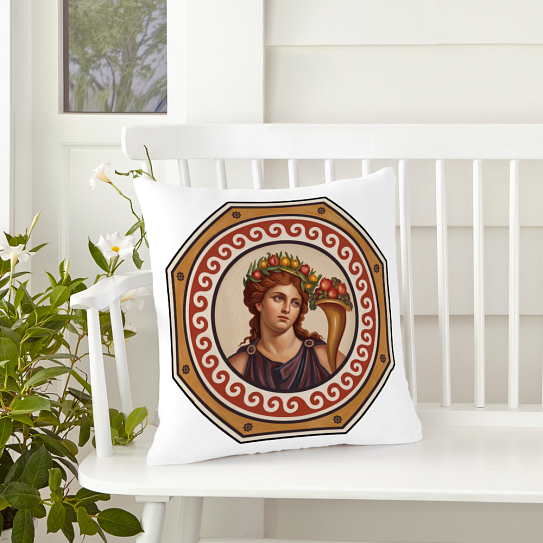
Put Roman Mosaic Art on Your Own Merch
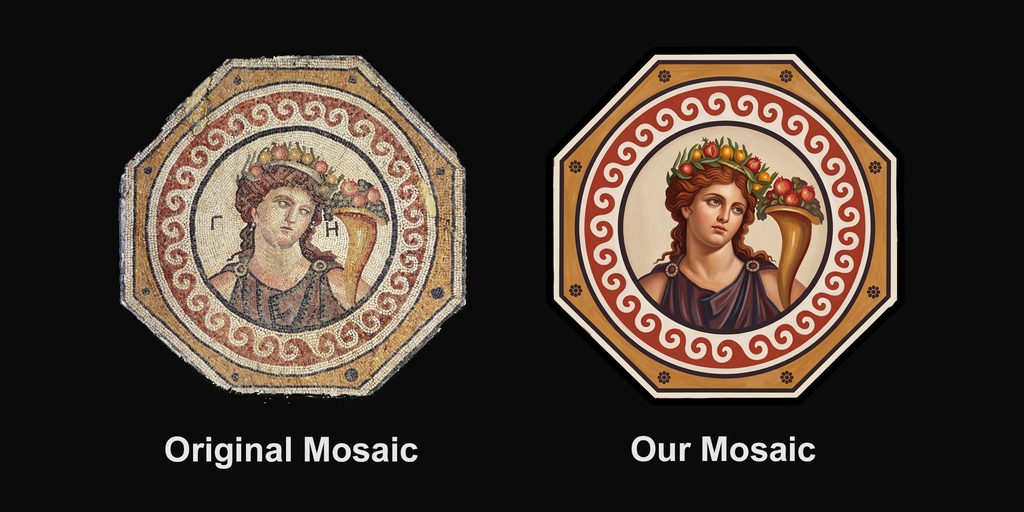
This modernized mosaic originated on a Roman villa floor in Turkey. It depicts Ge (earth). Now, it’s yours to put on the merch of your choice, such as: