Get a whole lot of attention when you wear this design around! Maybe one of these would be your style…

Or, check out this design on more than 50 items of high-quality merch right here.
Cocaine in Every Bottle
In the 1880s and 1890s, cocaine was not a street drug but a celebrated medicine sold openly at the pharmacy. Isolated from the coca leaf and promoted by doctors including Sigmund Freud, it was marketed as a cure for fatigue, toothache, depression, and more. After Carl Koller’s 1884 demonstration of cocaine as a local anesthetic, manufacturers like Merck and Parke-Davis mass-produced it, and the drug flooded everyday products. All of this was happening at the same time that heroin was showing up in various medications.
The Cough Drop Craze
Because no law required listing ingredients, cocaine slipped into tonics, wines, soft drinks, and cigarettes. Coca-Cola originally contained coca-leaf extract, and Vin Mariani, a coca-infused wine, won praise from popes and presidents. Yet nothing showed the era’s faith in cocaine like the cough drop.
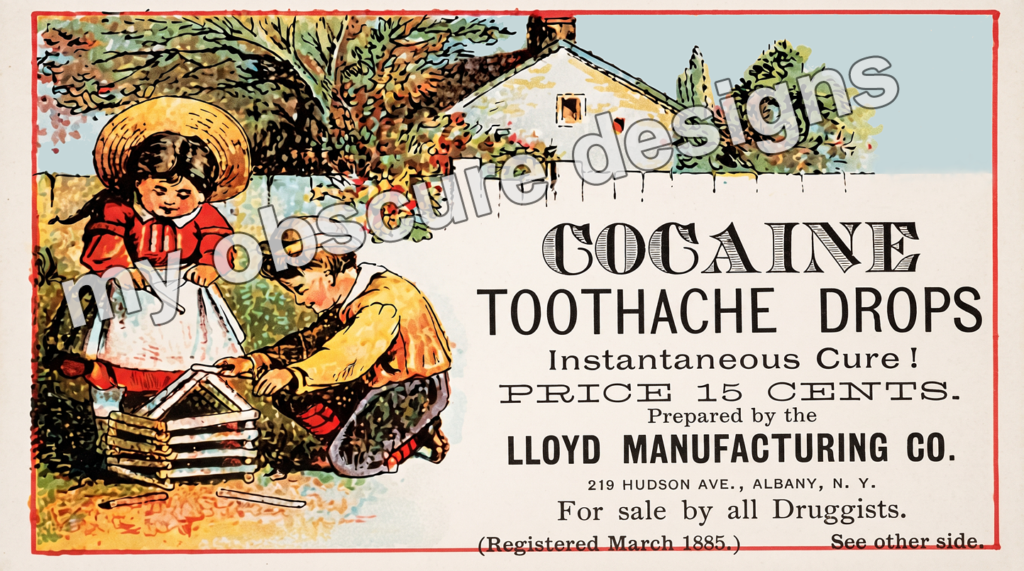
Lozenges that numbed a sore throat felt like instant healing, and druggists sold cocaine pastilles freely, often to children, since children caught colds. The cocaine toothache drops design shown above is an excellent example of this scary trend. Each candy-like drop delivered a numbing, mood-lifting dose, hiding an addictive stimulant inside a harmless-seeming product.
The Social Cost
Addiction spread across every class, from laborers to middle-class women sipping coca tonics for “nerves.” Chronic users suffered insomnia, paranoia, and hallucinations, while doctors coined “cocainism” to describe the wasting of patients who had simply followed the label. Sensational stories of “cocaine fiends” fueled a panic, tinged with racism, that justified both prohibition and discriminatory policing.
The End of a Bizarre Era
Reform came but it was slow. The 1906 Pure Food and Drug Act required honest labeling, and the 1914 Harrison Act regulated cocaine and opiates, pushing them off shelves. By the 1920s, the cocaine cough drop was gone. What began as a miracle ended, within a generation, as a warning.