
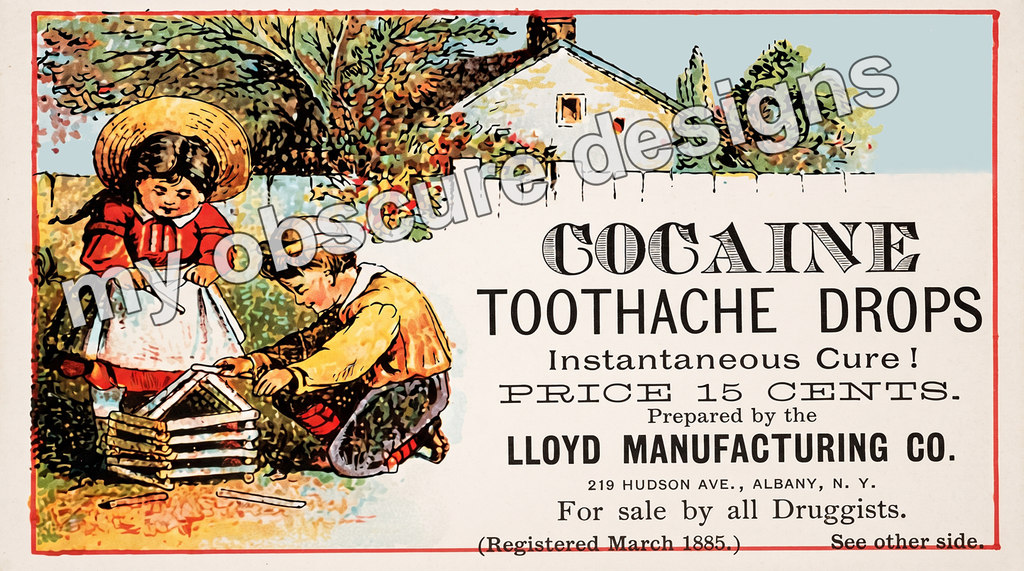
Cocaine Toothache Drops (19th Century Insanity!)
In the 1880s and 1890s, cocaine wasn’t a contraband street drug. It was a celebrated medical marvel sold openly at the corner pharmacy in things like cocaine toothache drops (yes, you heard that right). Extracted from the coca leaf and promoted by figures as prominent as Sigmund Freud, the alkaloid was marketed as a cure for everything from fatigue and toothache to depression, alcoholism, and hay fever.
Chemists such as Merck and Parke-Davis mass-produced it, and after Carl Koller’s 1884 demonstration of cocaine as a local anesthetic for eye surgery, physicians hailed it as a modern miracle. Before the century ended, however, the miracle had curdled into a public-health crisis.
A “Wonder Drug” on Every Shelf
Following its isolation in the 1850s and Koller’s breakthrough, cocaine flooded the patent-medicine market. Because no law required manufacturers to list ingredients, the drug slipped quietly into tonics, elixirs, powders, soft drinks, and even cigarettes sold to soothe asthma.
Coca-Cola, introduced in 1886, originally contained coca-leaf extract; Vin Mariani, a Bordeaux wine infused with coca, collected testimonials from a pope, European royalty, and former U.S. president Ulysses S. Grant.
Toothache drops, nasal sprays, and catarrh remedies promised instant relief. The promise was real, at least for a few minutes, because cocaine genuinely numbed the tissues it touched.
The Cough Drop Craze
Nothing illustrated the era’s faith in cocaine better than the humble cough drop. Sore throats and winter coughs were ubiquitous, and manufacturers reasoned that a lozenge that numbed the throat would feel like instant healing.
Druggists compounded cocaine pastilles behind the counter and sold them loose from glass jars, while national brands marketed reassuringly named “cough cures” that were little more than candy and cocaine.
Cocaine-laced lozenges like the design above were often aimed at children, since they caught colds. It numbed irritated tissue while the stimulating drug lifted the user’s mood.
Parents handed them over freely, unaware that each candy-like drop contained an addictive stimulant. The cough drop was the perfect Trojan horse: a familiar, harmless-seeming product that normalized daily dosing of a powerful drug.
The Social Cost of Easy Access
The consequences arrived quickly. Because cocaine was cheap, unregulated, and socially acceptable, addiction spread across every class, from laborers who used it to push through long shifts to middle-class women who sipped coca tonics for “nerves.” Chronic users developed insomnia, paranoia, hallucinations, and the notorious “cocaine bugs” sensation of insects crawling beneath the skin.
Doctors coined the term “cocainism” to describe the wasting condition they saw in patients who had simply followed the label’s instructions. Families were ruined, and by the turn of the century sensational stories about “cocaine fiends” and violent crime fueled a moral panic.
Even worse, the panic was laced with racism. Flagrantly false tales of cocaine-fueled rampages by Black men in the South were invoked to justify both prohibition and discriminatory policing.
The End of an Era
Reform came slowly and unevenly. The medical profession, which had once championed cocaine, began publishing accounts of addiction and tissue damage. In 1906, the Pure Food and Drug Act required manufacturers to label dangerous ingredients, making it harder to hide cocaine in a lozenge.
The 1914 Harrison Narcotics Tax Act went further, regulating and taxing cocaine and opiates and effectively moving them from the pharmacy shelf to the prescription pad and, eventually, the black market. By the 1920s, the cocaine cough drop had vanished, and the drug had been recast as a menace rather than a medicine.
The late-19th-century cocaine boom remains a cautionary tale. It shows how quickly an unregulated “wonder drug” can be woven into the most ordinary products (such as a soda, a cigarette, a child’s cough drop), and how long it takes a society to untangle the consequences. What began as a miracle ended, within a generation, as a warning.
Flaunt This Bizarre 19th Century Fad on a Variety of Quality Merch
Now, you can show off this cocaine toothache drops design on all kinds of high-quality merch.


Or, check out more than 50 products with this design right here.