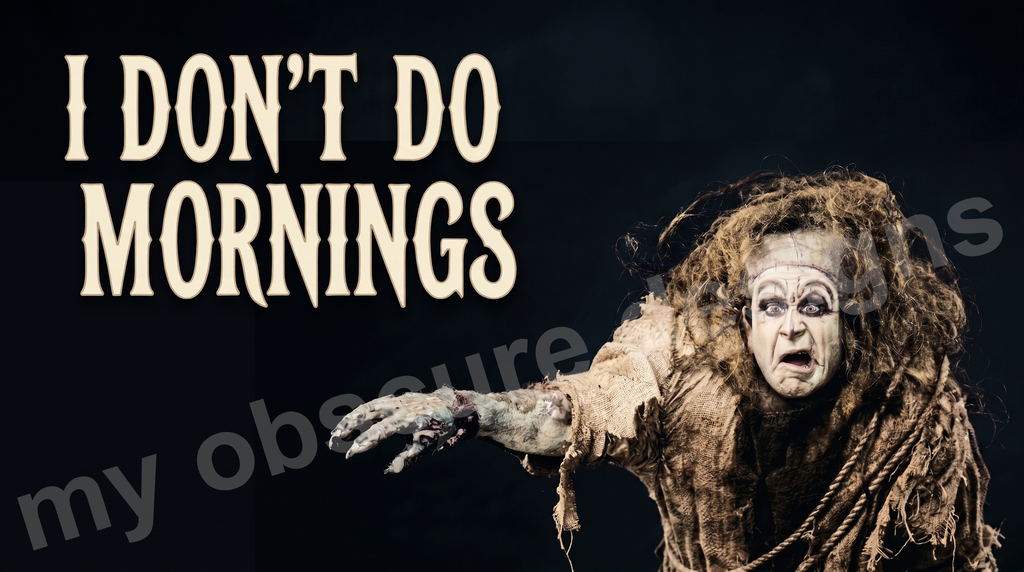
Mondays… who needs it? Luckily, some t-shirts are tailor-made for wearing on Mondays…

A complete line of products bearing this design are available right here. If you’re looking for other interesting or weird designs, click right here for more from My Obscure Designs.
Background: Thomas Edison’s 1910 “Frankenstein” Film
Thomas Edison’s Frankenstein, a one-reel film released by Edison Studios on March 18, 1910, is widely recognized as the first cinematic adaptation of Mary Shelley’s novel. Directed by J. Searle Dawley, the silent film starred Augustus Phillips as Victor Frankenstein, Mary Fuller as Elizabeth, and Charles Ogle as the Creature. Shot at Edison’s Bronx studio, it condensed Shelley’s story into a brief moral fable lasting roughly sixteen minutes.
Charles Ogle’s Creature
Charles Ogle’s performance and makeup are the film’s most enduring legacy. He created a gaunt, wild-haired, hollow-eyed figure in ragged clothing, reportedly designing much of his own appearance. This was the first screen Frankenstein monster, predating Boris Karloff’s famous portrayal by more than two decades.
Rather than being assembled from body parts, Ogle’s Creature emerges from a boiling chemical vat, a simplification suited to the one-reel format. The creation scene used a burning mannequin and reversed footage, making the figure appear to form out of smoke and flame.
Plot, Loss, and Rediscovery
After discovering the secret of life, Victor returns home, but the Creature follows and menaces Victor and Elizabeth. In the film’s symbolic climax, the Creature sees his own reflection in a mirror and, horrified by his appearance, vanishes, allowing the couple to reunite. This ending reduced Shelley’s tragic story to a simple moral about ambition and outward appearance.
For decades, Thomas Edison’s Frankenstein was believed lost. A nitrate print later surfaced in a private collection and was preserved by the Library of Congress, restoring Ogle’s pioneering performance to public view. Today, the film survives as a landmark of early horror cinema and an important example of Edison Studios’ narrative experimentation.